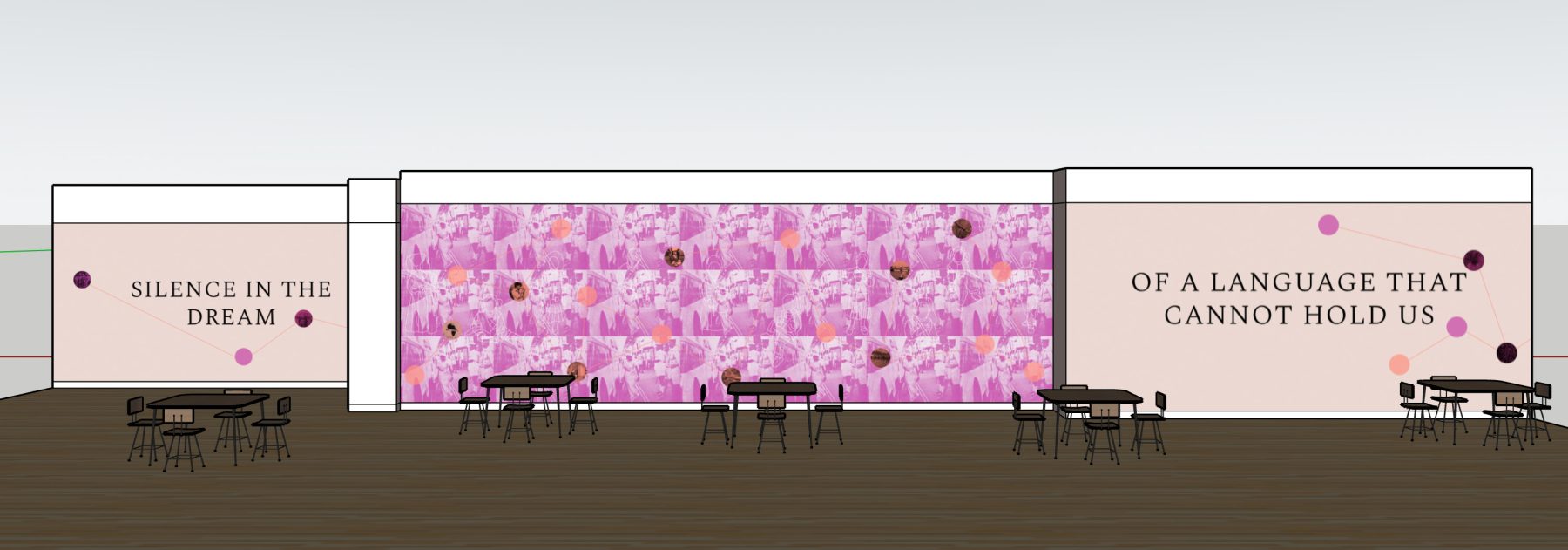
Silence in the Dream of a Language That Cannot Hold Us (2026)
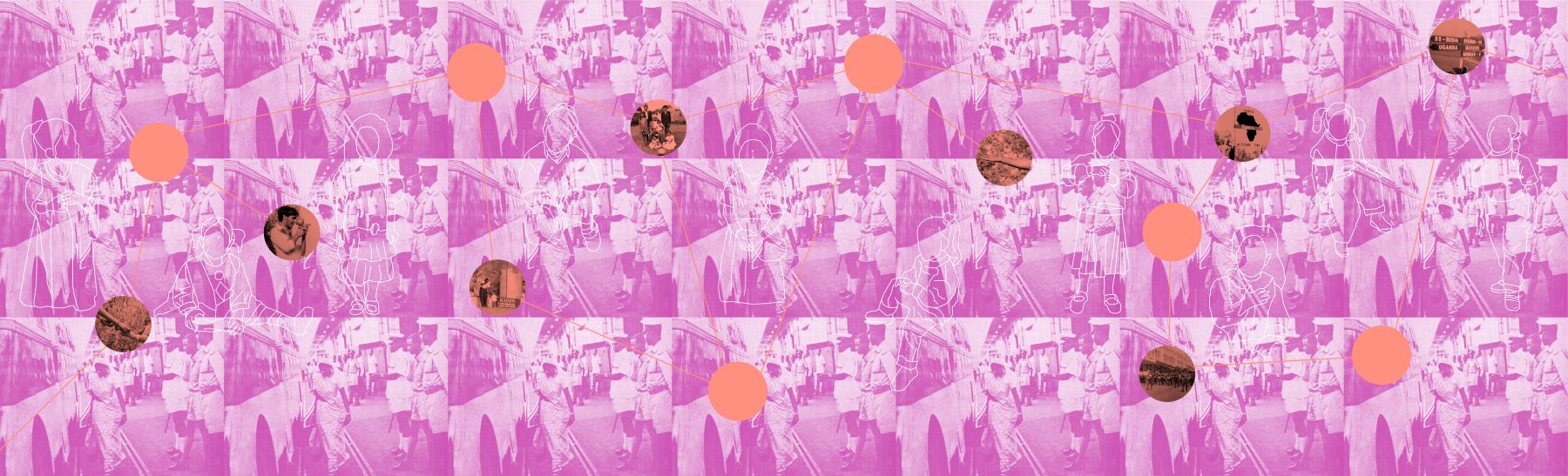
1972 marks both a political rupture and a threshold within Vora’s family history. Around 90,000 South Asians were forced to leave Uganda, and it is from within this history that this new commission takes shape. At its centre is a press photograph first published in the East African Standard that year, showing a South Asian woman being directed towards a bus by Ugandan army officers. Enlarged across the work, gestures of pointing, directing and control become part of its visual structure.
Circular images cut across the newspaper photograph, bringing material made and held within South Asian lives into direct contact with an image produced for public circulation. In doing so, the work brings the scale of displacement into relation with family life and social histories.
What emerges is not an attempt to complete the historical record, but to unsettle its terms. Images held privately or at the edges of public history become active agents in the production of history. Images surface and recede, moving between visibility and obscurity while resisting a single account of what happened and what followed.
Installed within Chapter’s café – a social and transitional space where people gather, pause and pass through – the work returns these images to a shared public space, asking what becomes visible in the aftermath of displacement.
Silence in the Dream of a Language That Cannot Hold Us (2026) is commissioned by Chapter Arts Center, Ffoto Gallery and Ffoto Cymru 2026. It is derived from an earlier iteration of the work,
Expressions in Your Histories, Overshadow My Memory (2024), commissioned by National Museums NI as part of the 20/20 project, and developed and reconfigured for this commission. Selected images reproduced in the work are drawn from the artist’s family archive and from the collection of Museum Rietberg, Zürich.